What a control joint actually does
Concrete shrinks as it cures. If the slab is restrained — and it always is, by friction with the base and by the elements around it — that shrinkage creates tension, and young concrete resists very little tension. The slab will crack; the only question is where.
A joint creates a weakened plane. By reducing the section along a straight line, it forces the crack to form directly under the cut, where it is invisible and can be sealed.
The window
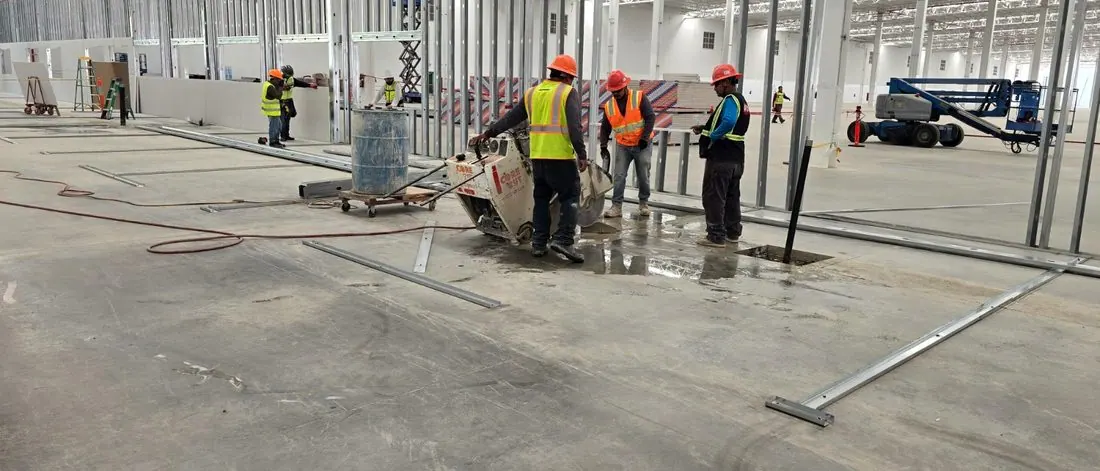
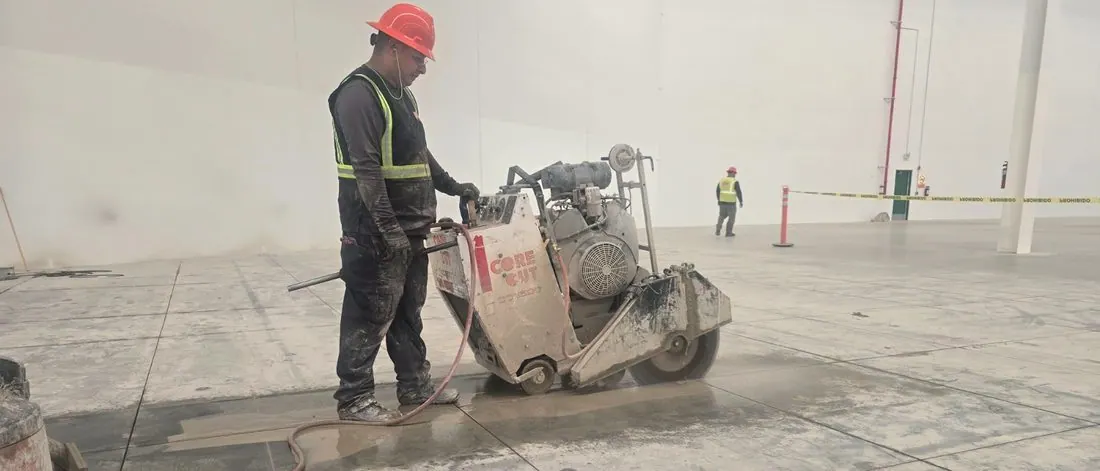
The cut must happen after the concrete carries the machine without ravelling and before shrinkage has already cracked the slab on its own. That interval depends on the mix, thickness, wind, humidity and above all temperature.
On a summer day in Tijuana, with direct sun and dry wind, the window shortens noticeably compared with a cool winter day. That is why the criterion cannot be a fixed number of hours: someone has to be on site testing the edge.
Depth and spacing
A cut that is too shallow does not create the weakened plane and the slab cracks where it pleases, often a few centimetres from the joint. The practical design rule is to cut on the order of a quarter of the thickness, and joint spacing is set in the design, not on site.
With a conventional blade saw you wait longer; with early-entry equipment you go in sooner and can cut shallower. Those are different criteria and they do not mix.
What to do if it already cracked
If the slab cracked before cutting, the joint no longer serves its purpose and cutting over it repairs nothing. The right move is to treat the crack: open it, clean it and inject or seal it depending on width and whether it is active. Cutting joints into an already cracked slab only adds lines.