The one-third rule
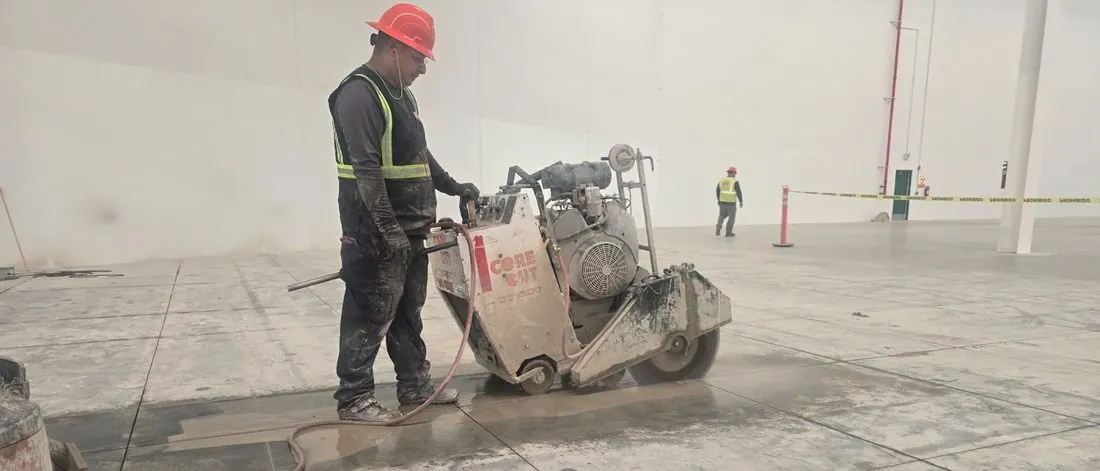
A cutting blade penetrates roughly one third of its diameter. A 900 mm blade cuts about 30 cm per face; cutting from both faces gets you to around 60 cm if the element is accessible from both sides and the cuts can be aligned accurately.
That arithmetic sets the first boundary. While thickness stays inside that range, the blade wins: it sets up faster, advances faster and costs less per linear metre. Once the element exceeds it, or when there is access from one face only, the blade stops being an option and wire territory begins.
Geometry: what a blade cannot wrap around
The second criterion is not thickness but shape. A blade cuts a straight line on a plane. If you have to separate a circular column, section an irregular bridge pier cap or cut around an element that must not be touched, a blade has no way to do it.
Wire, by contrast, adapts: the loop wraps the piece whatever its section and cuts by traction along the full contact. That is why in infrastructure demolition — piers, pier caps, deep beams — wire shows up even at thicknesses a blade could theoretically handle.
Access, noise and neighbours
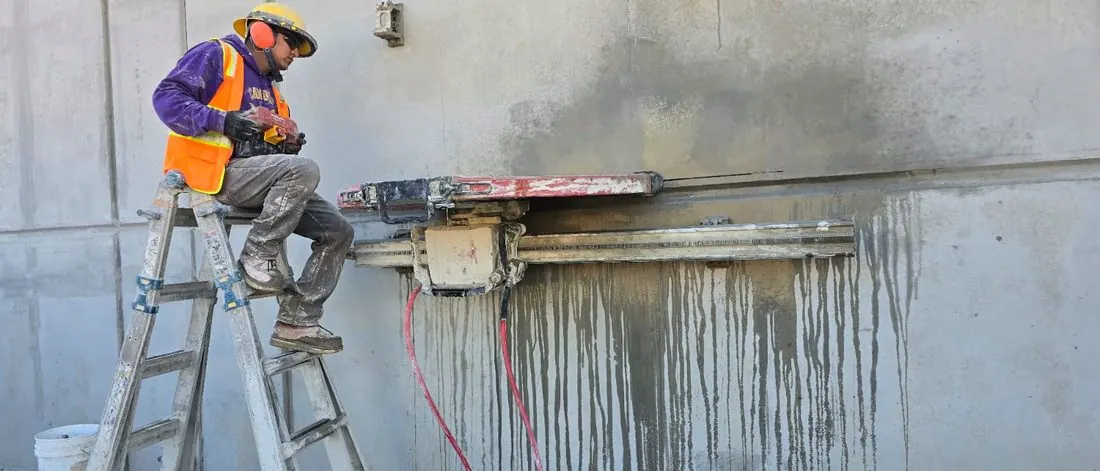
Urban work adds a third factor. A wall saw needs an anchored rail and room for the machine and the blade; a wire rig can sit several metres from the piece, with pulleys routing the cable wherever it is needed.
And the noise difference is not trivial: wire runs on a hydraulic power pack and a water pump, without the shriek of a blade attacking steel. In a hospital, school, hotel or residential zone with restricted hours, that difference decides whether the job can be scheduled in daylight.
The real cost is removal, not cutting
A common mistake when comparing quotes is looking only at the price per metre of cut. On large sections the expensive part is almost never cutting: it is moving what has been cut.
A cubic metre of reinforced concrete weighs around 2.4 tonnes. The break-up plan — how many blocks, at what weight, in what order and with which crane — drives cost and time far more than tool choice. When a proposal does not mention the lift plan, it is not comparable to one that does.